It's the second week in April. Holy Week and Easter will be here you know it. The Sunday after Easter (now known as Divine Mercy) promises to be an awesome celebration in Rome. Why? Pope Francis will be canonizing two holy men - Pope John XXIII and Pope John Paul II. To celebrate this important day and to educate our young Catholics on the office of Pope and Pope John Paul II in particular, Magnificat and Ignatius Press have released two gorgeous hardcover books - Our Holy Father, the Pope and John Paul II: The Journey of a Saint.
Our Holy Father, the Pope is an illustrated-hardcover book that introduces your children to the papacy and four influential popes (not counting Peter). The first half of the book is dedicated solely to St. Peter. In these sections, your children will learn about who Peter was, how he got his name, and how he became the first Pope and Bishop of Rome. Your children will also read abbreviated Scripture passages in which Peter appears, including him walking on water, him denying Jesus, and him being given the keys to the Kingdom. They will also learn about his martyrdom and being crucified upside down.
The next part of the book focuses highlights four important popes - Clement I, Leo the Great, Pius X, and John Paul II. Each page includes a brief biography of who they were before they became pope, why they were important popes, and their feast days. These were all good choices, and there are dozens that could have been chosen in addition to these four. In fact, I wish they would have highlighted more than four, but there is a limit on how many pages you can put in a book. The last section explains what the pope does, where he lives, and how the new pope is selected. With watercolor-like illustrations on every page and a thorough guide to the papacy, your children will be educated about who the pope is in no time. 5 stars!
John Paul II: The Journey of a Saint is another exceptional graphic novel illustrated by Dominique Bar. You might recognize the name, as he illustrated Saint Bernadette: The Miracle of Lourdes and Saint Joan of Arc: Quest for Peace. This graphic novel actually begins with the Treaty of Versailles in 1919. In the following year, Karol Wojtyla is born. We then get a glimpse of what looks like a typical childhood - a boy who plays sports, loves adventures, and goes to school. Tragedy soon strikes though when 9-year old Karol's mother dies at the young age of 45. We then see Karol growing up in Poland and having to deal with World War II and Communist Russia.
About halfway through the graphic novel, the papal election occurs and Karol becomes Pope John Paul II. We then get to see aspects of his papacy that made him so popular, including his many trips to other countries, World Youth Day, the multiple saints he canonized, and just his love of people. We see a lighter side of the Pope who still goes skiing with friends, and we see a near tragedy in an assassination attempt. Most importantly though, we see Jesus in everything that John Paul II said, did, and lived. Apart from the compelling biography, the illustrations were astounding! Dominique Bar did a magnificent job aging Pope John Paul II. Toward the end of this graphic novel, you could see the pain on the pages. It was like re-living his last days again.
I don't have enough good things to say about this book. As a fan of graphic novels, I found myself reading it and re-reading it. I was so absorbed I did not want to put it down. This book would make a perfect gift for teens or children who barely remember or never got to know who Pope John Paul II was. He is a prime example of a recent man who became a saint and an excellent role model. Although this book is designed for children, I see an audience for it with young adults as well, especially those who grew up with Pope John Paul II as the only pope they knew. It's also hardcover, so you know it will last for years to come! 5 stars!
These books were provided to me for free by Ignatius Press in exchange for honest reviews. If you found these reviews helpful, click here and here and hit Yes!
Showing posts with label Pope. Show all posts
Wednesday, April 9, 2014
Friday, October 25, 2013
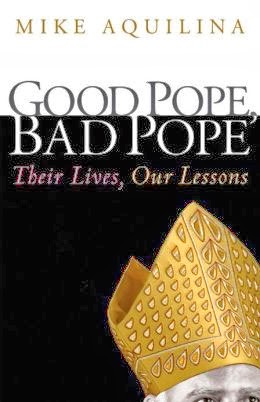
Good Pope, Bad Pope (Servant Books)
In the history of the Catholic Church, there have been 266 popes serving as leader to the world's Catholics for nearly 2000 years. Throughout that illustrious history, there have been some truly great popes, some mediocre popes, and some downright awful popes. The one thing that remains constant is their position as head of the Catholic Church; even through very trying times, the Church that Christ established has not collapsed under a single pope.
In the book, Good Pope, Bad Pope Mike Aquilina highlights a selection of popes through the history of the Church - starting with St. Peter and ending with soon-to-be St. John Paul II. Ten other popes are also examined, including one of my favorites, St. Clement, and some lesser known ones like Liberius and Vigilus. As the title suggests, some of the popes are good, and some are bad. However, Mr. Aquilina selected these twelve to show how the papacy developed through the centuries.
I particularly enjoyed the chapter on Pope Pius XII. Pope Pius XII reigned during the time of Nazi Germany. His reign was very polarizing, and there is no real middle ground on people's view of him. They have either staunchly defended him or vilified him, saying he didn't do enough for Jewish people during his reign. Mr. Aquilina did a masterful job presenting all the facts regarding what Pope Pius XII did to help Jewish people. The most impressive action Pope Pius XII took was opening up monasteries, convents, and even Castel Gandolfo to Jewish people as a place to hide. Detractors of Pope Pius XII would do well to realize that if it wasn't for him, thousands more Jewish people would have died.
It is no surprise to me, or to anyone who has read Mr. Aquilina, that he delivers another solid work with Good Pope, Bad Pope. There were plenty of good and bad popes he could have chosen to highlight in this book, but his selections were thoughtful and made sense. Before you get scandalized that he would willingly air the Church's dirty laundry, you should realize that the main purpose of this book is to remind us that the Church is not a man-made institution, but one established by Jesus Christ. This means that, despite the bad popes, the Church still has not erred in doctrinal teaching. If you want to read a fascinating book about twelve remarkable men, pick up this 5-star book!
Note: The back of the book says that an Afterword is included, which discusses Pope Benedict XVI's retirement and Pope Francis' election. There was a glitch in printing somewhere, and it only appeared in the digital edition, not the print edition. If you own the print edition and would like to read the Afterword, you can click here.
I received this book for free from Franciscan Media in exchange for an honest review. If you found this review helpful, please click here, and hit Yes!
In the book, Good Pope, Bad Pope Mike Aquilina highlights a selection of popes through the history of the Church - starting with St. Peter and ending with soon-to-be St. John Paul II. Ten other popes are also examined, including one of my favorites, St. Clement, and some lesser known ones like Liberius and Vigilus. As the title suggests, some of the popes are good, and some are bad. However, Mr. Aquilina selected these twelve to show how the papacy developed through the centuries.
I particularly enjoyed the chapter on Pope Pius XII. Pope Pius XII reigned during the time of Nazi Germany. His reign was very polarizing, and there is no real middle ground on people's view of him. They have either staunchly defended him or vilified him, saying he didn't do enough for Jewish people during his reign. Mr. Aquilina did a masterful job presenting all the facts regarding what Pope Pius XII did to help Jewish people. The most impressive action Pope Pius XII took was opening up monasteries, convents, and even Castel Gandolfo to Jewish people as a place to hide. Detractors of Pope Pius XII would do well to realize that if it wasn't for him, thousands more Jewish people would have died.
It is no surprise to me, or to anyone who has read Mr. Aquilina, that he delivers another solid work with Good Pope, Bad Pope. There were plenty of good and bad popes he could have chosen to highlight in this book, but his selections were thoughtful and made sense. Before you get scandalized that he would willingly air the Church's dirty laundry, you should realize that the main purpose of this book is to remind us that the Church is not a man-made institution, but one established by Jesus Christ. This means that, despite the bad popes, the Church still has not erred in doctrinal teaching. If you want to read a fascinating book about twelve remarkable men, pick up this 5-star book!
Note: The back of the book says that an Afterword is included, which discusses Pope Benedict XVI's retirement and Pope Francis' election. There was a glitch in printing somewhere, and it only appeared in the digital edition, not the print edition. If you own the print edition and would like to read the Afterword, you can click here.
I received this book for free from Franciscan Media in exchange for an honest review. If you found this review helpful, please click here, and hit Yes!
Thursday, August 29, 2013
CUA Press: A Service of Love
Welcome back to Stuart's Study! I am very excited to announce that Catholic University of America Press has agreed to let me review one of their books. Those of you who love the Church Fathers should be very familiar with their Fathers of the Church series. It was this series, which I first discovered at Auburn University's Library, that kept calling my name as I made my first few tentative steps on my journey to Catholicism. While I only own a few books in this impressive collection, I have a goal to one day own them all. Today, I will be reviewing A Service of Love, which I hope will be the first of many reviews for this wonderful publisher!
Ecumenism, or perhaps one day even reunion, between the Catholic Church and Orthodox Church has long been hindered by a few sticky subjects in high theology. These issues serve as points of disagreement and contention between people on both sides. Some of the major issues that plague these two groups include the primacy and infallibility of the pope and the Filioque as it relates to Trinitarian procession. Rev. Msgr. Paul McPartlan, a professor of Systematic Theology and Ecumenism at the Catholic University of America, addresses some of these issues in his work A Service of Love.
With fewer than 100 pages and only three chapters in this book, one might infer that this is a quick read. Don't be fooled by the relatively small size, though. Rev. Msgr. McPartlan packs these pages with depth and insight. Throughout this book, we are shown the contrast between primacy and collegiality through the millennia. For example, Pope Innocent III was the first to use the papal title "Vicar of Christ." Before him, all other popes used the title "Vicar of Peter." The book also states that Pope Innocent III believed that all bishops were "the members of the body of which he was the head." This contrast of primacy and collegiality led to the issue of jurisdiction. Cardinal Ratzinger offered a possible solution to the issue of primacy; he suggested the use of papal titles from the patristic era, such as, "first in honor."
To me, the most fascinating section in this book was the discussion of the Council of Vatican I. The only thing people really remember about that council was that papal infallibility was established/defined at that time. However, since Vatican I was cut short for political reasons, the bishops never had a chance to read and debate Tametsi Deus, which dealt more fully with bishops and the Church at large and was supposed to complement Pastor Aeternus, the document that dealt with the primacy and infallibility of the Pope.
This is a superb book, which is easily worth 5 stars. I consider myself of average to above average knowledge with regard to the subjects of papacy, primacy, and ecumenism, but I learned a great deal from this little tome. What I most appreciated about this book was that it didn't just present problems. It also offered possible solutions. We must come to accept and embrace that the primary ministry of the Bishop of Rome is "a service to the Eucharist, and to the ecclesial communion that flows from it." If you would like to better understand the subjects in the above paragraphs, this is the book for you. In fact, I would recommend it to Catholics and Orthodox alike. May the Eucharist unite what has been separated, and may there be unity of East and West in our day.
If you found this review helpful, click this link and hit Yes!
Ecumenism, or perhaps one day even reunion, between the Catholic Church and Orthodox Church has long been hindered by a few sticky subjects in high theology. These issues serve as points of disagreement and contention between people on both sides. Some of the major issues that plague these two groups include the primacy and infallibility of the pope and the Filioque as it relates to Trinitarian procession. Rev. Msgr. Paul McPartlan, a professor of Systematic Theology and Ecumenism at the Catholic University of America, addresses some of these issues in his work A Service of Love.
With fewer than 100 pages and only three chapters in this book, one might infer that this is a quick read. Don't be fooled by the relatively small size, though. Rev. Msgr. McPartlan packs these pages with depth and insight. Throughout this book, we are shown the contrast between primacy and collegiality through the millennia. For example, Pope Innocent III was the first to use the papal title "Vicar of Christ." Before him, all other popes used the title "Vicar of Peter." The book also states that Pope Innocent III believed that all bishops were "the members of the body of which he was the head." This contrast of primacy and collegiality led to the issue of jurisdiction. Cardinal Ratzinger offered a possible solution to the issue of primacy; he suggested the use of papal titles from the patristic era, such as, "first in honor."
To me, the most fascinating section in this book was the discussion of the Council of Vatican I. The only thing people really remember about that council was that papal infallibility was established/defined at that time. However, since Vatican I was cut short for political reasons, the bishops never had a chance to read and debate Tametsi Deus, which dealt more fully with bishops and the Church at large and was supposed to complement Pastor Aeternus, the document that dealt with the primacy and infallibility of the Pope.
This is a superb book, which is easily worth 5 stars. I consider myself of average to above average knowledge with regard to the subjects of papacy, primacy, and ecumenism, but I learned a great deal from this little tome. What I most appreciated about this book was that it didn't just present problems. It also offered possible solutions. We must come to accept and embrace that the primary ministry of the Bishop of Rome is "a service to the Eucharist, and to the ecclesial communion that flows from it." If you would like to better understand the subjects in the above paragraphs, this is the book for you. In fact, I would recommend it to Catholics and Orthodox alike. May the Eucharist unite what has been separated, and may there be unity of East and West in our day.
If you found this review helpful, click this link and hit Yes!
Subscribe to:
Posts (Atom)