Showing posts with label Mike Aquilina. Show all posts

Friday, June 15, 2018

The Apostles and Their Times (Sophia Institute Press)

If you want to learn about the Early Church Fathers (and Mothers), then the author you need to read is Mike Aquilina. He has provided Catholics with countless books, which are both excellent and approachable, and I am forever grateful for each and every one of those books. Today, I am reviewing one of his newer books called The Apostles and Their Times. I consider it a prequel of sorts to his other books, because without the Apostles, we wouldn't have the Fathers.

The book begins with an introduction that defines five key terms - minister, martyr, bishop, liturgy, and Eucharist. We then begin the book with a history of the Israelites and the value they placed in Jerusalem. To the Israelites, Jerusalem was the center of their world, and from this heavenly city, they awaited for their messiah to appear. When Jesus finally does arrive, there are several branches of Judaism (Pharisees, Sadducees, and Essenes) and each of them were looking for their own version of the Messiah. Therefore, few people accepted Jesus was the Messiah, because he wasn't the messiah they were looking for. Chapter Two explains to us what an Apostle is and how the term rarely appeared in the Gospels, but cropped up numerously in Acts and the Epistles. This leads us to the chapter on Pentecost, which is where the Church was born! The book continues by talking about martyrdom, Saul's persecution, and the new importance of Rome thanks to Peter and Paul.

Within this book, we not only are are treated to portraits of who the Apostles were, but through ancient documents and recent archaeological findings, we get to see them in their cultural context. This not only gives us a clearer picture of them, but also helps humanize these saints as well. By seeing them through the lens of their time and culture, we realize these weren't superhuman people, but fallible men just like us. They had strengths and weaknesses, temptations and sins, just like us. However, they relied on God, persevered, and most all were martyred for their beliefs. It was this witness of martyrdom that helped the Church to not only survive, but grow and thrive and continue on to this very day. Highly recommend this book, and any book that Mike Aquilina writes.

This book was provided to me for free by Sophia Institute Press in exchange for an honest review.

Monday, February 13, 2017

How the Choir Converted the World (Emmaus Road Publishing)

Music is an essential part of every society. It's art. It's a distraction. It elicits emotions. It's how people express themselves. It's how history is recorded and stories are remembered. Music is also a vital part of religion. In his latest book, How the Choir Converted the World, Mike Aquilina tells us how effectively the earliest Christians used music.

The book begins by taking us back to the Old Testament. The Babylonian Exile has ended. The Temple has been rebuilt. The people have been purified. And then, we have music! Aquilina then takes us even further back and shows us who was Biblically credited with creating the first instruments (Jubal). We also see references to Miriam's song, the walls of Jericho, and the many Psalms of David. The second chapter details music as it was used with pagan sacrifice. Aquilina even goes so far as to compare ancient Roman culture with our culture and how the music and entertainment then was just as abhorrent as what passes today for music in popular culture.

The book then walks us through important figures and moments Church music history. It begins by discussing music in the times of Apostles, which leads to Ephrem, Ambrose, and Augustine. The book ends with a chapter dedicated to the Te Deum and a closing chapter about what we need to make music more central to our Church again. Aquilina firmly believes that if we utilized music the way the early Church did, then we could change the world for the better.

As with all of Mike Aquilina's books I have read, he shows a great deal of research and scholarship to argue his case effectively. I really like that he continues to focus heavily on the early Church, as it is sadly a forgotten time that more Christians could benefit from learning about. As someone who doesn't have a musical bone in his body and therefore doesn't appreciate music as much as I should, I walked away from this book a lot wiser and more informed. I normally attend an early enough Mass during the week, specifically because there is no singing. However, having learned about both the history and significance of music in the early days of the Church, I realize now that I should not avoid music, merely because I lack the ability to beautifully make it, but I should seek it out and let it transform my life. In doing so, hopefully, I can make a little difference, and slowly perhaps we can transform and convert the world.

This book was provided to me for free by Emmaus Road Publishing in exchange for an honest review.

Wednesday, June 3, 2015

A Scriptural Study of Angels (CSS International)

Catholic Scripture Study International was founded in 2003 and has published approximately 30 Bible and faith-related study programs from great Catholic minds like Steve Ray, Fr. Larry Richards, Dr. Scott Hahn, and Mike Aquilina to name a few. The studies comprise both Old and New Testament books, as well as topics like the Mass, the Rapture, and the Second Vatican Council. Today, I will be reviewing A Scriptural Study of Angels, which is actually two programs in one. It comprises Entertaining Angels and Angels Throughout the Ages. The programs are written by Mike Aquilina and Dr. Richard Bulzacchelli, respectively, and both are presented by Fr. Mitch Pacwa.

Entertaining Angels is comprised of the following ten lessons:
1. An Introduction to Angels
2. The Angels' Creation and Fall
3. The Angels and Prophecy
4. Guardian Angels
5. Angels and Worship
6. The Holy Angels and the History of Salvation
7. The Orders of Angels
8. A Confusion of Spirits
9. Spiritual Combat
10. True Devotion to Angels

Angels Throughout the Ages is comprised of the following fifteen lessons:
1. Who are the Angels?
2. Satan in the Book of Job
3. The Dragon in Revelation, Chapter 12
4. The Accuser
5. The Serpent in the Garden
6. Leviathan
7. Beyond the Bible: Quetzalcoatl and Our Lady of Guadalupe
8. Beelzebub
9. What About Lucifer?
10. Moloch, Hamashhit, the "Destroyer" and Angel of Death
11. The Demon, Asmodai
12. Holy Raphael, the Archangel
13. Holy Gabriel, the Archangel
14. Holy Michael, the Archangel
15. What We Have Learned, and a Few More Angels

You can start with either study, but Entertaining Angels seems to be more introductory to me, so that is the one I would recommend. Each lesson is presented wonderfully by Fr. Mitch Pacwa, but he does take some getting used to if you have never watched him on EWTN. He has a bit of a dry, sarcastic humor that you'll appreciate the more you watch him. Depending on how much you know about angels will dictate how much you learn from each lesson. In addition to a video for each lesson, there's study material which includes Scripture readings, Points to Ponder, Study/Reflection Questions, Catechism References, and a "Rome to Home" section which includes a quote, generally from a past Pope. The leader's manual also contains suggested responses to help facilitate discussion.

When it comes to reviewing Bible studies, you don't pick favorite lessons.You pick the ones that taught you something new or spoke to you. In Entertaining Angels, Lesson Two dealt with the Creation and Fall. The angels were the Light created, and the Light being separated from the Darkness were the angels and fallen angels being separated. I have an icon that reflects this teaching, but it was an enlightening nonetheless. Angels Throughout the Ages Lesson Fifteen discusses angels not found in the Bible, but in apocryphal texts and traditions not generally known in Western Christianity. We learn about Uriel, Jehudiel, Selatiel, and Barachiel. In addition to telling what the angels' names mean, we learn what their responsibility is. For example, Barachiel is in charge of all the guardian angels on earth.

These two studies combined to make the most impressive and comprehensive studies on angels, I have ever encountered. It was in-depth and drew on many different sources to educate the study participant. Whether you are a new small group leader or a veteran, you will find plenty of help to facilitate this study effectively. This was my first experience with Catholic Scripture Study International, and I have nothing but positive recommendations for this program and their company in general. I can't wait to check out other studies from them, especially their new one on Isaiah. If you are in the need of a study, be sure to give this company a shot!

Wednesday, January 28, 2015

The Ancient Path (Image Books)

When it comes to reading about the Church Fathers, one of the first names people think of is Mike Aquilina. Aquilina's works have introduced the Church Fathers and Mothers to a whole generation of Catholics and made them accessible and relatable. His most recent book, The Ancient Path, is a joint effort with John Michael Talbot. Talbot is most widely known for his music career, but he is also the founder of an integrated Catholic monastic community called the Brothers and Sisters of Charity. This book, The Ancient Path, is the result of conversations that Talbot and Aquilina had one November week in 2012.

The book begins with Talbot discussing his monastery, Little Portion Hermitage, and the events of what happened April, 29, 2008. There was a massive fire, which completely engulfed the chapel. In addition to the tragedy of seeing something you built by hand destroyed, the community also lost their library which consisted of thousands of volumes. I have never experienced this level of literary loss, but as someone who himself owns a large library of books, my heart ached for him and his community. Talbot, however, used this tragedy to teach us a lesson in both detachment to worldly goods and the fact that once you have read and pored over some works, they are forever etched on your heart. He then concludes the the chapter with a juxtaposition of physical fire and spiritual fire. His example for spiritual fire involves the popular story of Abba Joseph encouraging Abba Lot to become all flame.

Other topics discussed in this book include charity, community, and stewardship. Each chapter has roughly the same format. Talbot talks about his life, his community, and what the Church Fathers taught him as it applies to the specific topic. Chapter 6: The Prayer of the Heart talks about The Jesus Prayer, "Lord, Jesus Christ, have mercy on me a sinner." Most Western Catholics aren't familiar with this prayer, but it is one of the chief prayers in Eastern Orthodoxy and Eastern Catholicism. The author does a great job discussing the history and evolution of the prayer, the impact it had on him; and also breaks the prayer down phrase by phrase. I do wish he would have offered a bit of caution in both practicing this prayer and reading the Philokalia. Someone advanced in their wisdom, like him, might not find it troublesome, but it is highly discouraged for a novice to attempt reading the Philokalia, and strongly urged you consult your spiritual advisor before trying.

Overall, this was an interesting book. It reminded me a lot of Aquilina's other works and Dr. Scott Hahn's early works. By that I mean, it mixes theology with personal experiences to make the subject matter more approachable. It also reminded me a bit of My Sister the Saints in that it read like a personal memoir with the Church Fathers serving as our guide through Talbot's life. If this sounds interesting to you or you can't get enough to read about the Church Fathers, then this book is for you.

This book was provided to me for free by Image Catholic Books in exchange for an honest review. If you found this review helpful, please click here and hit Yes!

Wednesday, September 10, 2014

The Feasts (Image Books) Review and Giveaway

It's been a few months since the last blog tour I participated in, but I am participating in two this month. The first one is sponsored by Image Books and is spotlighting their latest book The Feasts by Cardinal Donald Wuerl and Mike Aquilina. Those involved in the blog tour will provide you with a review of the book and a personal reflection on the Feast or Season. My season is Advent. There will also be a giveaway at the end of this post open to all in the U.S., so read all the way through and don't just skip to the bottom. Finally, you might see #TheFeasts on Facebook or Twitter, if you click on it, it should take you to other people's reviews, thoughts, and reflections. Without further ado, here is my review!

The Feasts is the third, and most likely final, book in a series of books written by Cardinal Wuerl and Mike Aquilina, which are designed to instruct Catholics and non-Catholics on important aspects of the Catholic Church. The first two books in this series are entitled The Mass and The Church. In The Feasts, the authors begin by explaining the value and importance that man places in calendars and tracking of time. They use the example of fishermen using the lunar calendar and farmers the solar calendar to grow rich, and state that if we follow the Church Calendar, we can grow spiritually rich. They then walk us through the Jewish feasts that Jesus celebrated when he walked this earth. Following this a whole chapter is dedicated to defining terms like Memorial, Solemnity, Season, and Octave.

The book then gets to the heart of the matter with the remaining chapters. The authors first start by talking about the importance of Sunday and then there are individual chapters dedicated to Christmas, Easter, and Pentecost. Next, they dedicate individual chapters to important solemnities of Jesus, including Epiphany, Ascension, Corpus Christi, and Christ the King. Unfortunately, the Annunciation and Presentation of Jesus in the Temple got lumped in with Christ the King. These are two important feast days, and considered part of the Twelve Great Feasts in Eastern Christianity. Next, we are treated to various other feasts and seasons, including Holy Trinity, Marian feasts (which could have easily taken up more than one chapter), and the Holy Angels.

I was very pleased that they devoted a chapter to Advent, as it is my favorite liturgical season. In this chapter, the authors discuss the beauty of Advent. Advent is a time of waiting and preparation, not a spend four weeks shopping season. In this season, we are preparing for the two-fold coming of Christ, both at Christmas and again at the end of the age. They also explain that the Eastern Christians view this as a season for purification and penance. I particularly enjoy Advent, because it is the start of a new Church year. It is a time to start over, begin again, and grow closer to God.

Overall, this was a good book with a lot of great information. I appreciate that the Eastern Catholics were not ignored in this book. However, there are a few things I would have changed. As I said earlier, I wish there had been more focus given to some of the particular feasts. I also think the book could have been a bit better organized. Since there was a great bit of focus on the importance of calendars and seasons, I think the book should have been arranged in the order the seasons and feasts appear on the calendar, starting with Advent and ending with Christ the King. Those complaints aside, this was still a good book that can teach both converts and cradle Catholics a lot.


a Rafflecopter giveaway

Monday, December 23, 2013

The Mass (Image Books)

Back in May, I had the pleasure of reviewing Cardinal Wuerl's and Mike Aquilina's book The Church. (Click here if you're interested in reading the review.) In my reading of this work, I learned that it was actually a follow-up to the book The Mass. I desperately wanted to read this book, and I told myself that if the book became available to review again, I would jump at the chance. Luckily for me, Image Books recently re-released The Mass in a more affordable trade paperback format, so I saw my chance to review this book and seized the opportunity!

The Mass is the first in a series of books by Cardinal Donald Wuerl and Mike Aquilina which highlight key aspects of what make Catholics, well, Catholic. The book begins with a brief introduction on the Mass as being something we do. It is not merely some event we show up to observe but an active prayer we participate in fully. The book is divided into two parts. Part One highlights origins, history, and items used at Mass. Part Two walks us through the entire Mass part by part from the Procession to the Dismissal.

What I found the most fascinating in Part One was the history of the Mass. We all know that this Eucharistic celebration has its origins at the Last Supper. Historical aspects the normal Catholic doesn't know, e.g., the standardization during the Middle Ages, are BRIEFLY covered in this chapter. I wish there had been more pages devoted to the history of the Mass. However, I appreciate the authors acknowledging that it is impossible to cover the history in a few pages, let alone a few volumes, but I wish they would have suggested some further reading on this matter.

As opposed to picking a favorite chapter in Part Two, I picked a slew of them. To b e more specific, I really enjoyed the chapters that focused on the Liturgy of the Eucharist, which starts with the Offertory and ends with Holy Communion. This part of the Mass was one that I always wanted to understand and appreciate more, and this book definitely helped me grow in understanding. I got to read some of the prayers the priest says quietly over the chalice and when washing his hands. It was also interesting to note that when priest mixes the wine and water, it used to serve a purpose but now has several symbolic meanings, including the union of divine and human and the water and blood pouring forth from Christ's wounds.

This book is the perfect introduction to learning about the Mass and would make the perfect gift for people in RCIA or reverts looking to rediscover their Catholic faith. It is also a good read for faithful cradle Catholics just looking to deepen their love and understanding for the Mass. I believe it would also make a great gift for seminarians or new priests, though I'm sure veteran priests would enjoy it too. Basically, what I'm saying is that this book is a benefit to everyone. Once you get done reading this one, you should check out the sequel The Church. Hopefully, there will be a third book in this series in the near future.

This book was provided to me for free by Image Books. If you found this review helpful, please click the link and hit Yes!

Friday, October 25, 2013

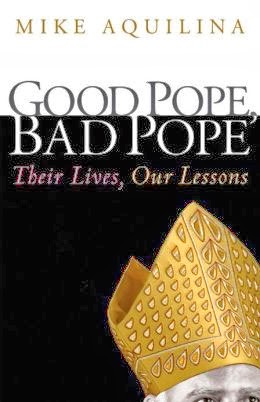
Good Pope, Bad Pope (Servant Books)

In the history of the Catholic Church, there have been 266 popes serving as leader to the world's Catholics for nearly 2000 years. Throughout that illustrious history, there have been some truly great popes, some mediocre popes, and some downright awful popes. The one thing that remains constant is their position as head of the Catholic Church; even through very trying times, the Church that Christ established has not collapsed under a single pope.

In the book, Good Pope, Bad Pope Mike Aquilina highlights a selection of popes through the history of the Church - starting with St. Peter and ending with soon-to-be St. John Paul II. Ten other popes are also examined, including one of my favorites, St. Clement, and some lesser known ones like Liberius and Vigilus. As the title suggests, some of the popes are good, and some are bad. However, Mr. Aquilina selected these twelve to show how the papacy developed through the centuries.

I particularly enjoyed the chapter on Pope Pius XII. Pope Pius XII reigned during the time of Nazi Germany. His reign was very polarizing, and there is no real middle ground on people's view of him. They have either staunchly defended him or vilified him, saying he didn't do enough for Jewish people during his reign. Mr. Aquilina did a masterful job presenting all the facts regarding what Pope Pius XII did to help Jewish people. The most impressive action Pope Pius XII took was opening up monasteries, convents, and even Castel Gandolfo to Jewish people as a place to hide. Detractors of Pope Pius XII would do well to realize that if it wasn't for him, thousands more Jewish people would have died.

It is no surprise to me, or to anyone who has read Mr. Aquilina, that he delivers another solid work with Good Pope, Bad Pope. There were plenty of good and bad popes he could have chosen to highlight in this book, but his selections were thoughtful and made sense. Before you get scandalized that he would willingly air the Church's dirty laundry, you should realize that the main purpose of this book is to remind us that the Church is not a man-made institution, but one established by Jesus Christ. This means that, despite the bad popes, the Church still has not erred in doctrinal teaching. If you want to read a fascinating book about twelve remarkable men, pick up this 5-star book!

Note: The back of the book says that an Afterword is included, which discusses Pope Benedict XVI's retirement and Pope Francis' election. There was a glitch in printing somewhere, and it only appeared in the digital edition, not the print edition. If you own the print edition and would like to read the Afterword, you can click here.

I received this book for free from Franciscan Media in exchange for an honest review. If you found this review helpful, please click here, and hit Yes!

Saturday, August 3, 2013

Our Sunday Visitor: The Fathers of the Church Bible

If you follow my blog and books I review, you should know three at least three things about me. I LOVE Bibles, the Fathers of the Church, and Mike Aquilina's books. Therefore, when I heard that there was a Bible being published called The Fathers of the Church Bible and that Mike Aquilina was involved in the project, I knew I had to own a copy! Unfortunately, my excitement quickly faded once it arrived in the mail. Before I get to what I didn't like about the Bible, let me give some basic details about the Bible.

The translation of this Bible is the New American Bible Revised Edition, also known as the NABRE. This is the version you hear proclaimed at every Mass, so you know this is a faithful translation. Like your basic NABRE Bible, you get both the NAB and NABRE introductions. You also get footnotes and cross-references. How is this Bible different then? There are 88 color inserts in the Bible with writings from the Church Fathers on topics such as the Canon, Baptism, Angels, etc. I would have liked for these inserts would be placed near the Scripture passages that they address, but instead they are just spread about evenly to make for a uniform distribution.

Let me start with the positive aspects of this Bible. The Fathers of the Church Bible itself is a paperback, but the pages have a nice weight to them. The font is easy to read, and the Scripture cross-references and notes are easily separated on the page to make for easy navigation and easier reading. The margins aren't very large if you are looking for a Bible to make notes in. I am not, so that wasn't a deal-breaker for me. The inserts are especially enlightening and full of important teachings. I am VERY pleased that St. Ephrem the Syrian merited his own insert, as he is too often overlooked and forgotten.

As for the negatives, it is mainly the combination of presentation and price that I find lacking with this Bible. If you are looking to buy your FIRST copy of the NABRE Bible, then this would be a good choice. If you already own a copy of the NABRE, then you will be a little disappointed with this Bible. In my opinion, the inserts would have been better served as a small booklet sold separately. So if you already have a NABRE Bible, then I wouldn't recommend getting this one as well, because the inserts don't justify the cost. You would be better served buying a copy of one of Mike Aquilina's many books on the Church Fathers.Overall, I would give this Bible 3.5 out of 5 stars. I expected much more from this Bible, and I believe it could have been better than it was.

This review was written as part of the Catholic book reviewer program from The Catholic Company. Visit The Catholic Company to find more information on The Fathers of the Church Bible. The Catholic Company is the best resource for all your seasonal needs such as First Communion gifts as well as ideas and gifts for the special papal Year of Faith.

Monday, May 13, 2013

Image Books: The Church

Well, we officially have less than a week of Easter left. We are entering the second half of the longest season of the Church Year - Ordinary Time. A lot of people, myself included, tend to flounder in this season. They have no fasting to re-focus their life, as in Lent or Advent, and no Great Feast to look forward to like Easter or Christmas. So instead of treating Ordinary Time as a dry season, pick up a book and learn something new. I recommend The Church by Cardinal Donald Wuerl and Mike Aquilina.

The Church begins simply by explaining what a church is and why people are willing to sacrifice so much and live in poverty to construct these lavish and ornate buildings. It then goes on to explain what THE Church is, as in one, holy, catholic, and apostolic.  He also explains some of the different names for it, including Mother and Ship to name a few. You may think this is all very basic information that most people know, but the book then progresses to my favorite part. It breaks down every aspect and feature of a church and explains the historical, physical, and spiritual significance of each feature.

Some features of a church might be obvious. For example, a lot of churches are cruciform shaped to represent the Body of Christ, which is the Church. Other features of a church though hold more significance than one realizes. The Ambo for example is the place where the Word of God is proclaimed. This is, in fact, a second table. The first table is the altar, where the Bread is broken. The second table is the Ambo, where the Word of God is broken.  To put it plainly, this is where the Sacred Scripture is opened, read, and explained to us. The most enlightening passage to me was the part on the Sacristy. Being a convert, I never had the chance to be an altar server, and so I have never experienced this room. It was truly enlightening learning the spiritual dimension of a space that seems to be a mere dressing room to many.

The Church is a 5 star book that is excellent for the convert and cradle Catholic alike. This building that so many take for granted is more than just a building. It is full of both physical and spiritual beauty and reading this book will open your eyes to all that beauty. So take the time to read this book and see how your church and the churches in your area compare to the descriptions in this book and to each other. Then, when you get done with this book, pick up its companion book called The Mass. You won't be disappointed with what you find.  I received this book for free from WaterBrook Multnomah Publishing Group for this review.


Some helpful links related to this book are below, and as always, if you found this review helpful please click the link and hit Yes!
More Info
Read Chapter One
Author Bio